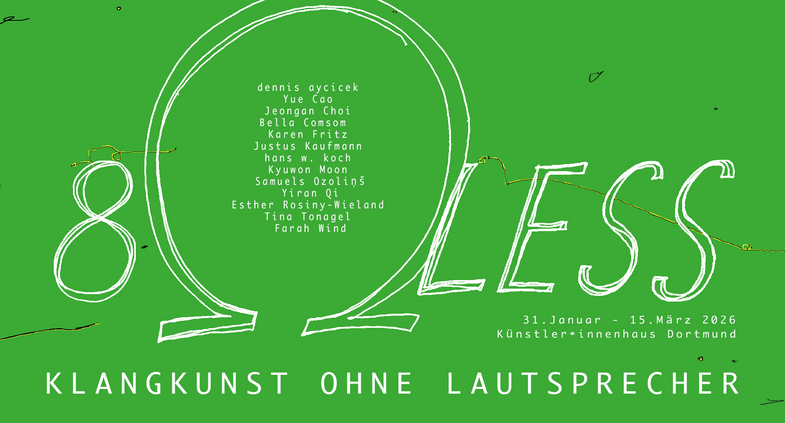
Stroking, scratching, striking, plucking, scraping, blowing, imagining – this exhibition focuses on the creation of sounds through mechanical processes. The artists explore sound as a sculptural medium, deal with aspects of auditory perception, and reflect on the aesthetic and conceptual possibilities of sound-producing objects in space.
Tools include Arduinos, sensors, and motors, but also water and air. Only loudspeakers are not allowed.
The exhibition is a cooperation with the sound department of the Academy of Media Arts Cologne.
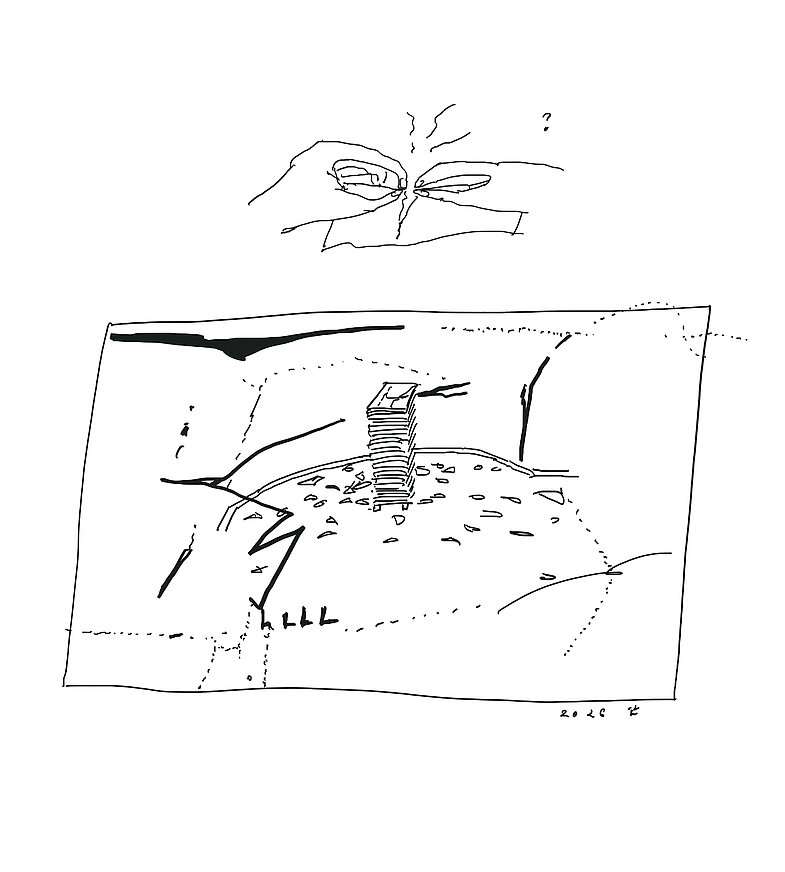
The work began with reflections on the relationship between the act of tearing paper, the sounds it produces, and the images formed through this action. Upon entering the space, a visible paper stack allows audiences to engage with the paper by following the drawn lines, applying varying force and direction. While certain guidelines exist, each act of tearing generates distinct sounds and shapes, shaped by differences in pressure and speed.
The resulting paper forms become part of a larger whole while retaining their individuality. Depending on the image one receives, the torn paper may be placed into a pocket or discarded onto the floor, thereby initiating yet another chain of mediated randomness.
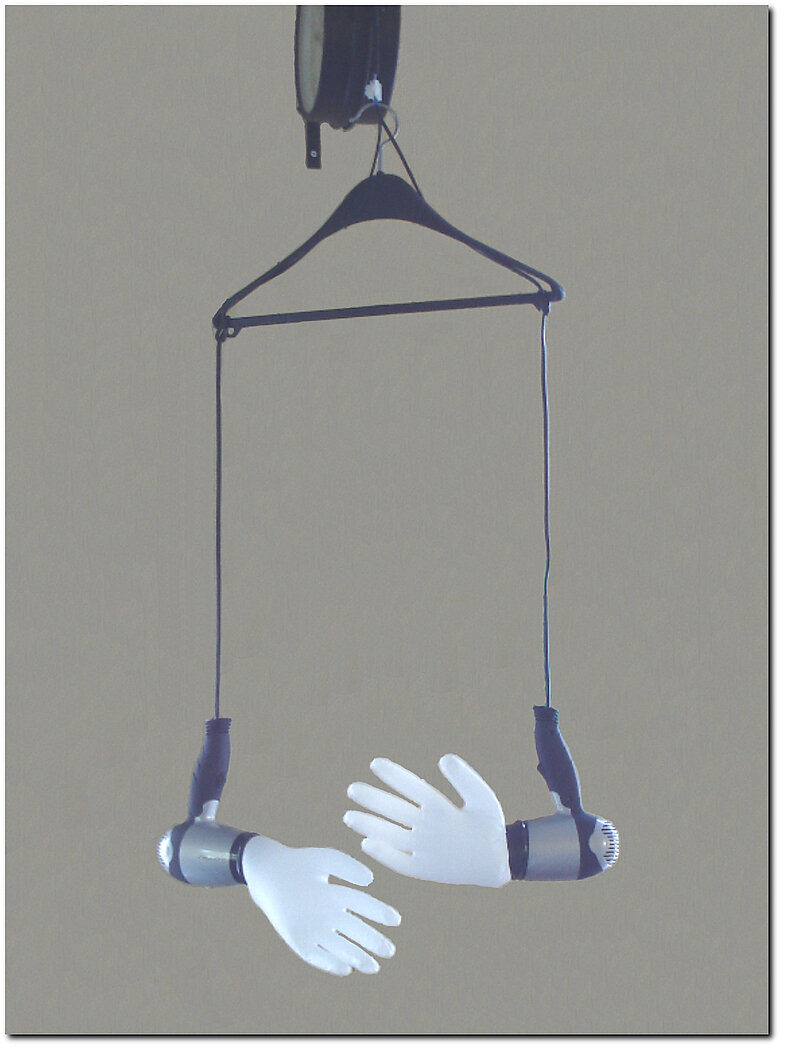
Two hairdryers, their vents blocked by rubber gloves, blow until their thermic protection turns them off. When they have cooled down, they start blowing again. Their individual rhythms lead to a handshake at irregular intervals of about 1 1/2 hours.
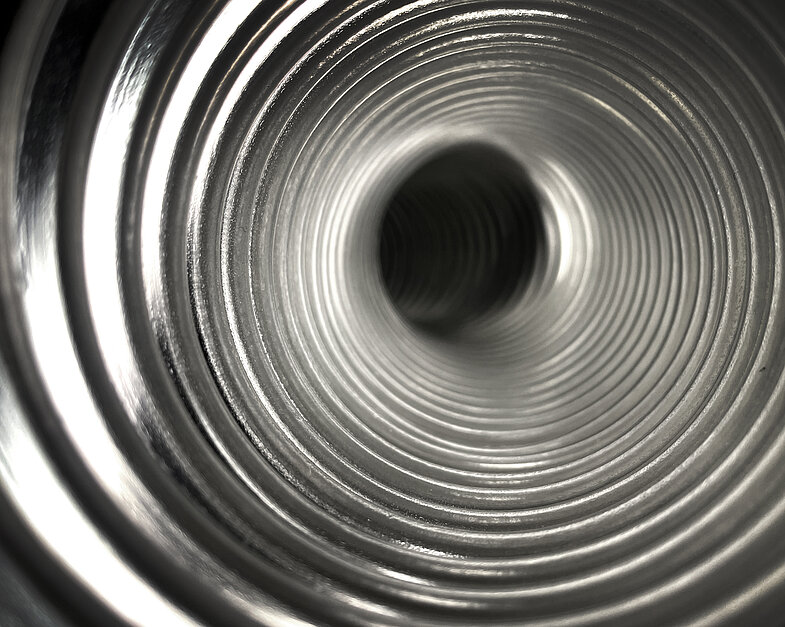
Ear Trumpet is participatory sculpture inspired by the observation of how elderly individuals sometimes raise their voices. As their hearing declines with age, they may raise their volume in an attempt to hear themselves more clearly. The work explores how vocalizations of varying intensity create an auditory presence. Within the spherical structure of Ear Trumpet, the audience can experience how their voices resonate and fill the interior space.
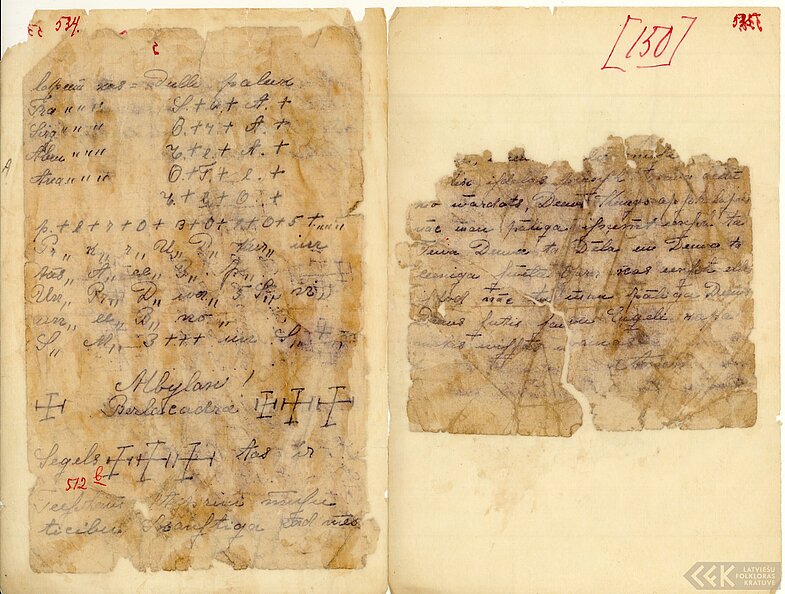
There are more than 19,000 Latvian charm words preserved in the Latvian Folklore Archive. Passed down orally and by inheritance, they were used to heal people and animals, offer protection, attract good fortune etc. With the spread of literacy in Latvia—strongly influenced by Herrnhut missionaries—written traditions emerged. Among them were the Debesu grāmatas (Books of Heaven): hand-copied collections of charm words, biblically inspired texts, magical letter and number combinations, and folk medicine recipes. These DIY grimoires appropriated Christian symbolism and became peculiar mixtures of religious motifs and local beliefs. They were hidden at home, or carried for protection and distributed by secretly rewriting.
In this work the Christian Catholic home altar tradition is appropriated by making altars from found and scrap materials and exchanging the crucifix with a puzuris (himmeli) and a note with charm words. These charms, used against all ailments, are believed to work only when spoken aloud, though they can also be carried as protectors. The notes may be opened, read and/or written down by the visitors. Please use with caution and leave them where and how you found them.
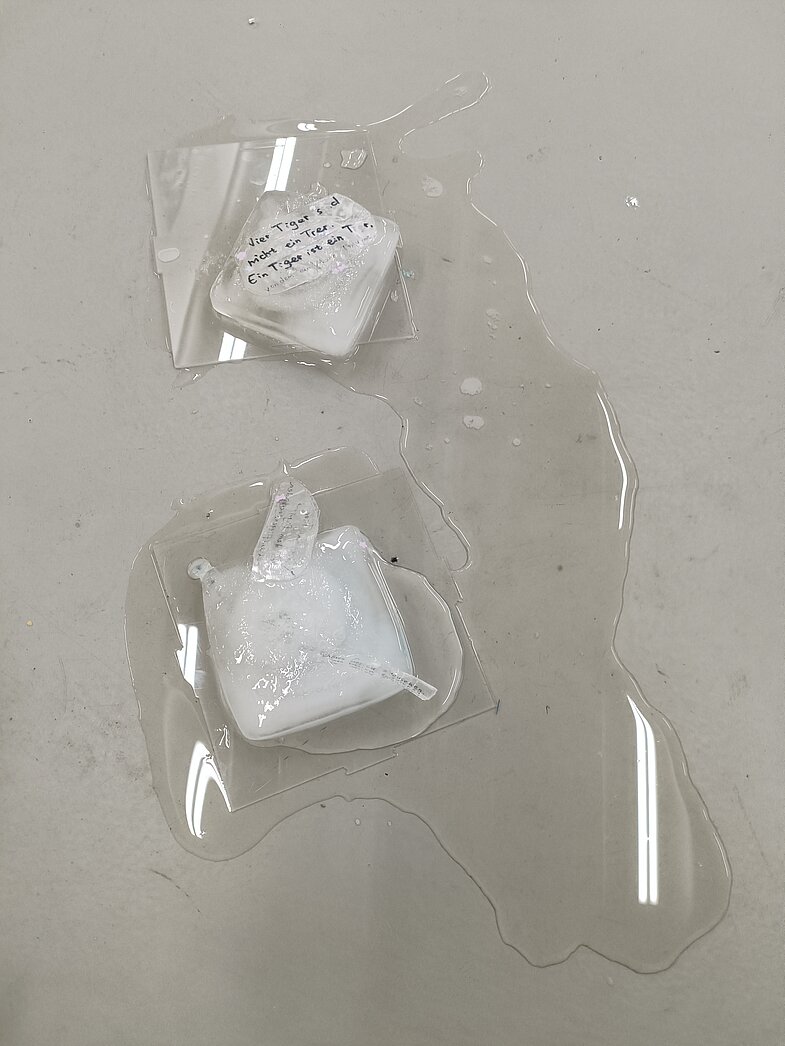
During a live performance, ice is presented as a body, pierced by metal. As the ice continuously melts, the metal embedded within it falls away piece by piece. Sound gradually disappears during this process. Listening to the process of the body being forgotten, imagining the disappearance of sound. After the performance, the exhibition presents its remnants: photographs of the performance, process-based materials, and imaginative records of sound. These remains do not reproduce the performance, but point to a state in which something was once present and is now absent. The work focuses on the relationship between the invisible, the body, and memory.
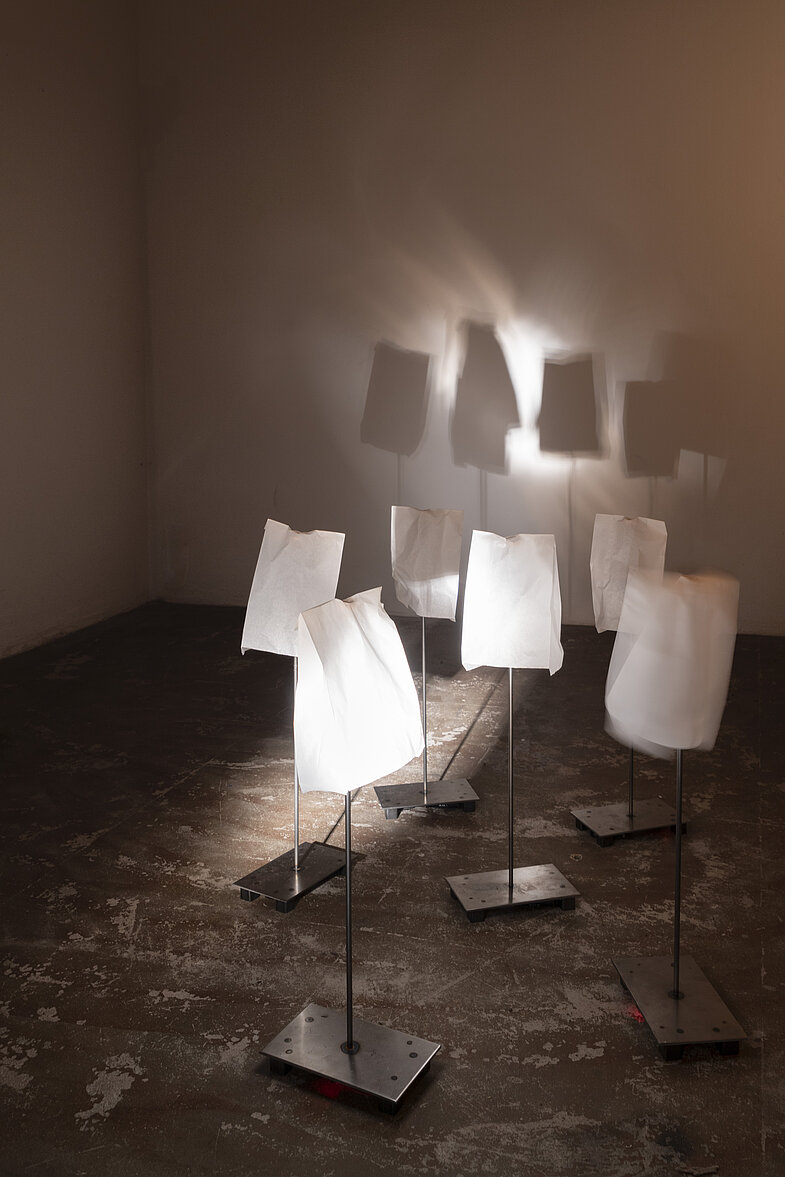
Using several invisible ESP32 modules, the paper bags rotate around their own axis, sometimes individually, sometimes together. The sound of the paper is quiet and depends on the position of the paper bags on the stands.
31 January - 15 March 2026
Preview / Curator's tour
Friday, 30 January, 5.30 pm
Opening
Friday, 30 January, 7 pm
Artists:
dennis aycicek
Yue Cao
Jeongan Choi
Bella Comsom
Karen Fritz
Justus Kaufmann
hans w. koch
Kyuwon Moon
Samuels Ozoliņš
Yiran Qi
Esther Rosiny-Wieland
Tina Tonagel
Farah Wind
Curator:
Ach Kuhzunft in cooperation with the sound department of the Academy of Media Arts Cologne
Title graphic: Jeongan Choi & dennis aycicek
Images work: © the artists
Sound Perfomance
Saturday, 21. February, 8 pm
Kindly supported by:
Kulturbüro Dortmund, Bergmann Bier
Motor-driven tin can kalimba
Workshop with Ralf Schreiber
8 February, 12 pm