
The exhibition highlights various facets of the body and corporeality in five artistic positions. Kinetic objects, sculptures and videos by Birgit Brenner depict bodily desire and unfulfilled longings in relationships, as well as material desires. In the theatrical presentation of a 3D video animation and specially composed music Dominik Geis shows masculine role models, ideologies and power structures. The beginning of new life: In an environment and a vocal performance, alongside with singer and dancer Leonie Türke, Ja Jess blends science and the reality of life with poetry and the mysticism of centuries past. Janis Löhrer focusses on queer identity and desire, as well as loneliness, anonymity and shame, transporting visitors into a profane sporting setting. René Spitzer’s large-scale paintings transform monumental, mythical battle scenes into the present day, as allegories of universal fights.
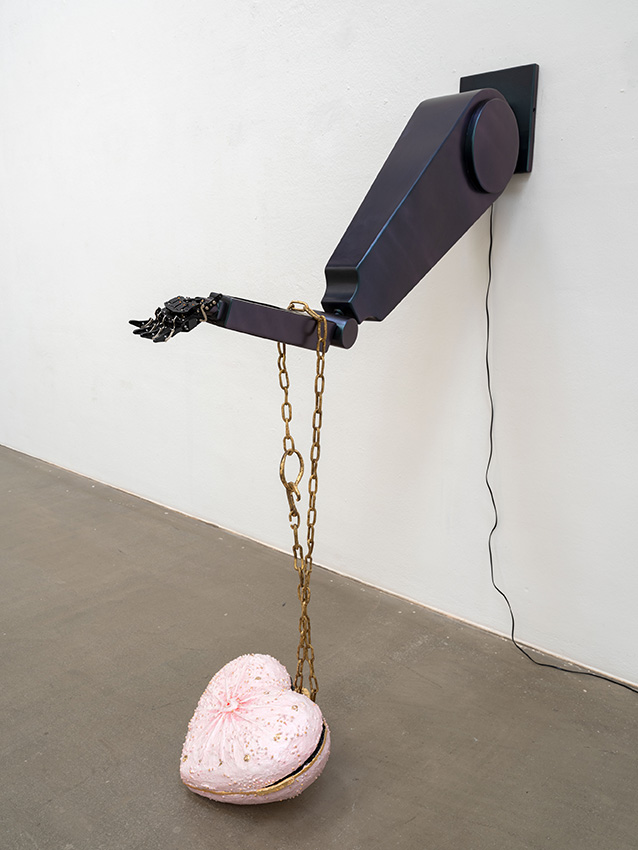
Birgit Brenner (*1964) uses her very own visual language to explore various social and private impacts and fears, as well as the challenges of everyday life. Her socially critical works circle around topics like injustice, failure, the promise of happiness, loneliness, fear, and, increasingly, the irreversible consequences of human impact on the planet in the Anthropocene era. In her cross-media works, Brenner questions man-made structures and systems, particularly with regard to their absurdity in oscillating between creative innovation and destructive force.
This gives rise to large-scale installations as well as intimate drawings and video projections. By juxtaposing analog and digital visual patterns, perfection and do-it-yourself, real life and artificial construction, she formulates commentaries and questions on current issues.
Birgit Brenner earned her master’s degree in 1996 from the Berlin University of the Arts and has been teaching as a professor of installation art at the State Academy of Fine Arts in Stuttgart since 2007. In 2020, she was a fellow at the Villa Massimo in Rome and a recipient of the Wolfsburg Art Prize.
www.eigen-art.com/kuenstlerinnen/birgit-brenner/arbeiten/installationen
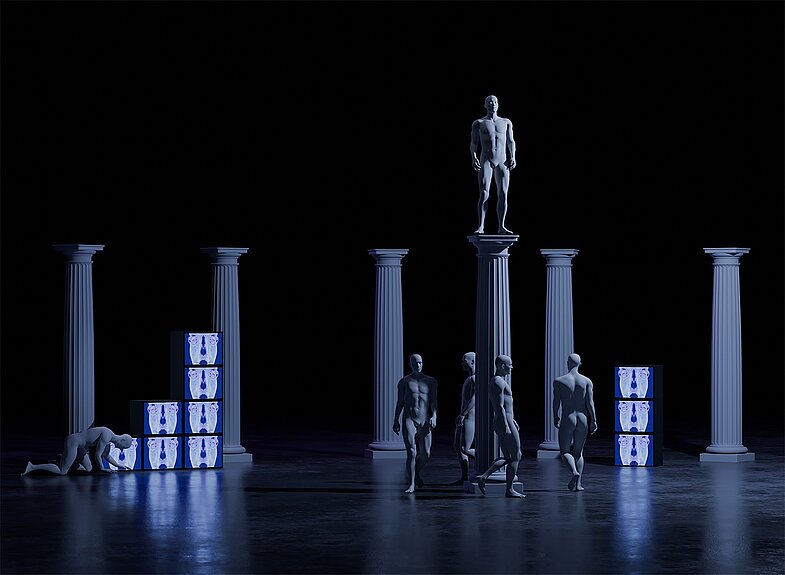
At the centre of Dominik Geis’s artistic practice is the body as a stage and mirror of social, cultural, and media-driven inscriptions. Geis explores how norms, power structures, and ideologies shape the body, and how media representations and digital technologies transform the perception of corporeality. His work includes choreographic video collages made from found footage, weaving image, time, and sound into dynamic dramaturgies.
His 3D video animation rhythm stages recurring patterns of society. At its centre are gestures and representations of masculinity: digitally animated figures perform gestures and movements that make culturally shaped bodily techniques and conceptions of masculinity visible. A digital stage space with televisions and projections composed of found-footage collages provides the setting for the animated figures. The continuous camera movement and the specially composed music connect visual, performative, and sonic layers. A live performance complements the staging.
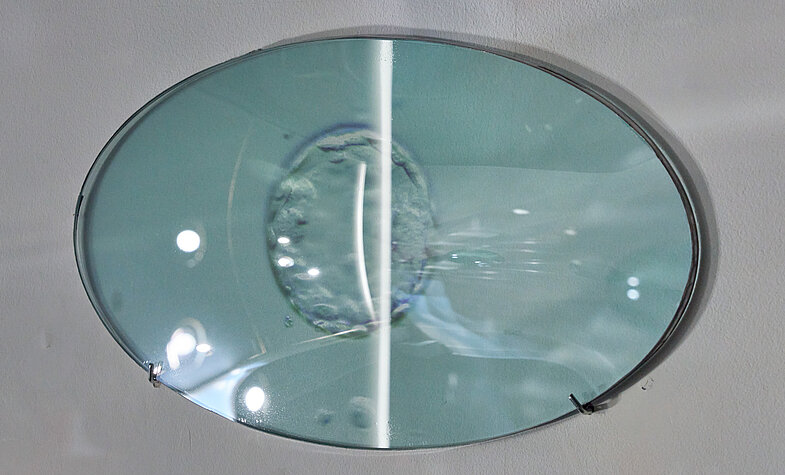
Ja Jess (@jajess_x) understands their performativity as an artist as gestalt giving glitches between physical presence and future ancestors. They write corporal compositions where voice becomes the oscillating superimposition of bodies and anatomy a collective fleshly archive passed on as a prosthetic touch into the stratigraphy of social architectures.
With entering such mystified positions in the theatricality of true societal contexts, Ja Jess presents within the current exhibition their body of work Baby Was Born Dreaming introduced by the performance Donor: The Rumours Are Heirs. Alongside singer and dancer Leonie Türke (@leolacy_).
Based on Jess‘s own DNA - which was sequenced as part of an actual egg cell donation Ja Jess performed in Denmark - and a reference DNA sample, Jess has created a virtual embryo. The performance incorporates spoken text, chants of Hildegard von Bingen and voice compositions based on DNA sequences of the embryo‘s base sequences. The liturgical chant also symbolizes oral transmission across generations, while the movements point to the interconnectivity of bodies. They are further inspired by the reflexes of newborns, who anatomically still incorporate their relationality to their surroundings.
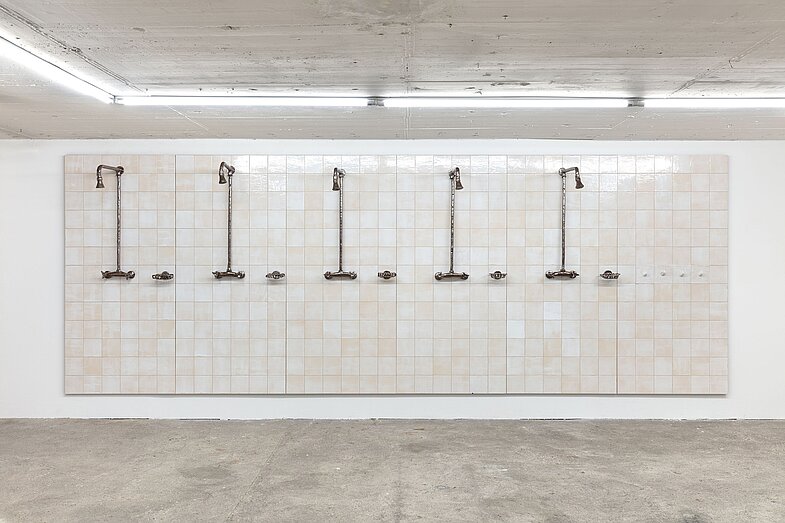
Janis Löhrer (born in Aachen in 1991, lives and works in Berlin) studied Fine Arts and Painting at the Kunstakademie Düsseldorf and graduated with a diploma in 2019. Following his first institutional solo exhibition at Neuer Aachener Kunstverein in 2025, his work continued to be exhibited at Galerie Martinetz in 2026, followed later this year by group exhibitions at KIT, Düsseldorf and Museum Morsbroich in Leverkusen.
Central to Janis Löhrer’s artistic practice are questions of queer identity, embodiment, masculinity, and shame. His work approaches public space as a stage for hidden encounters and homosexual desire, while searching for moments of privacy and solitude within it.
„Personal hygiene is regarded as an intimate sphere of individual self-determination. The spaces designed for it are intended to provide privacy, while simultaneously undermining it through their semi-public character. Communal showers embody this contradiction: hygiene spaces that are particularly common in male-dominated team sports and prisons. In the Gemeinschaftsdusche (Communal Shower), tensions emerge between physical vulnerability, socially conditioned notions of sexuality, and gender-affirming self-presentation. Privacy and voyeurism probe the boundaries of one another. Janis Löhrer’s ceramic installation Gemeinschaftsdusche [...] engages with these ambivalences, transposing the private-public experience of showering into an exhibition space removed from everyday life.“ (Weststern, 2026)
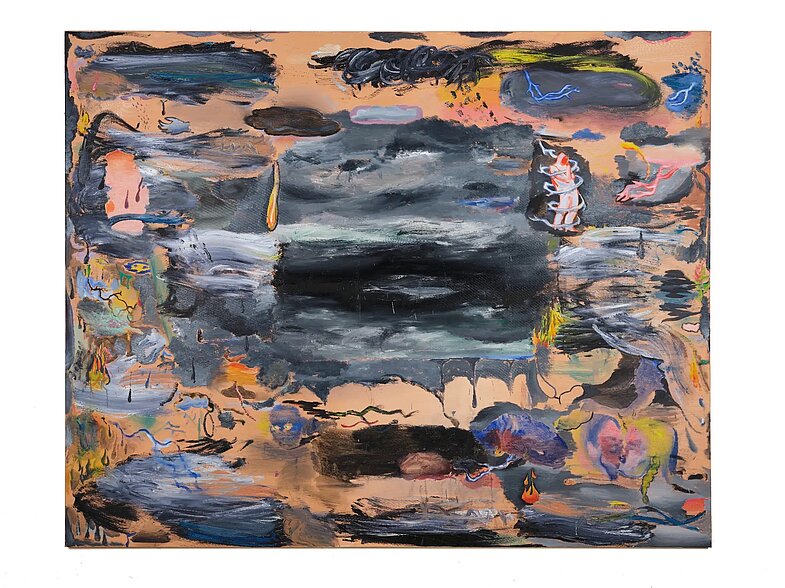
Rene Spitzer (born 1978) studied at the Kunstakademie Düsseldorf from 2002 to 2009. He lives and works in Düsseldorf. His work has been presented in numerous solo and group exhibitions in Germany and internationally, including at NANZUKA Underground in Tokyo (2015), TICK TACK in Antwerp (2019), and Kunsthalle Recklinghausen (2024).
In Rene Spitzer's paintings, the fury of a post-punk showdown collides with the reality of contemporary painting. Becoming an image is not a result. It is the condition in which the painting operates. One gesture is enough to send everything that has congealed back into flux.
Each form comes at the cost of another; every decision shifts what came before. Forms wander, change function, and resurface elsewhere. The painting follows its own inner necessity.
His works resemble open wounds, yet they are also jubilant expressions of unquenchable beauty, the two inseparably intertwined. His motifs morph across colours, genders, and species, shifting in a split second into something figural, sculptural, or kinetic.
He sends figuration through a purgatory of toxic yellow, burning orange, and impending cloudbursts. Faces implode. Bodies fragment with visceral immediacy. Landscapes mutate into fluid spaces in a permanent state of exception.
Falling is for the damned; floating is for the saints.
Silvia Y. Tam and Marco Siedelmann
21 November 2026 - 10 January 2027
Preview / Curator's tour
Friday, 20 November, 5.30 pm
Opening
Friday, 20 November, 7 pm
Artists:
Birgit Brenner
Dominik Geis
Ja Jess
Janis Löhrer
René Spitzer
Curator:
Dagmar Lippok
Performances
Donor: The Rumours Are Heirs.
Ja Jess with Leonie Türke
Friday, 20 November, 8 pm
rhythm
Dominik Geis
Friday, 20 November, 9 pm
Curator's tour
Sunday, 22 November 2026, 4 pm
Finissage / Curator's tour
Sunday, 10 January 2027, 4 pm
Title graphic: Jens Sundheim
Images works: © the artists
Kindly supported by:
Kulturbüro Dortmund, Bergmann Bier